Spend about 11 minutes online researching the infinite banking concept and you will hear a lot of noise. Some people call it an investment. Some call it life insurance. Some call it a scam. Then there is the guy who financed 17 Lambos and a goat farm with one policy.
Let me give you the simple version.
What is the infinite banking concept?
It is a way to control how you finance the things you will need throughout your lifetime. You also recapture the interest you would otherwise pay to someone else’s bank or finance company.
The essence is ridiculously simple.
Is infinite banking an investment?
No. It is not a mutual fund, a stock, crypto or real estate. It is not in an investment category at all.
It is a process. It is a way of organizing your capital so you are in a position of total and absolute control.
Isn’t it just whole life insurance?
No. That is like asking, “Isn’t Amazon just a warehouse?”
There is a warehouse involved. You build a warehouse of wealth. But that is not the business.
The tool used to implement the process is dividend-paying whole life insurance, ideally with a reputable mutual company. Confusing the process with the tool is like confusing a hammer with home building. The hammer matters. But what matters most is the house once it is built.

How does it actually work?
Here is the simplest explanation I have ever given.
You pay premium in exchange for dividend-paying whole life insurance. The contract immediately begins accumulating cash value. That is the net present value of the future payment of a death benefit.
Cash value is not money. But the insurance company allows you to borrow against it and use it as collateral. That does not interrupt any of its daily growth.
The insurance company lends you its money. You repay the policy loan on your schedule. Meanwhile, your policy, or ideally your system of policies, keeps doing what it was engineered to do: grow.
That is it. There is no secret behind the curtain.
Can you really become your own banker?
The phrase can cause confusion. People hear it and think they will no longer need banks. That is impossible. Banks perform valuable functions, including moving a lot of capital around the planet.
R. Nelson Nash developed the infinite banking concept. I was blessed to be mentored by him for many years. He taught two fundamental truths.

The first is that your money must reside somewhere. The second is that someone or some organization must perform the function of banking as it relates to your needs.
You are financing everything you buy. Even when you pay cash, you make a financing decision. You withdraw the money, and you can never earn interest on that cash again. That is lost opportunity, and it has a cost.
Think about cars, homes, businesses, education, renovations, appliances, equipment and taxes. You take part in the function of banking every day. So who is the banker for your needs?
When we say “become your own banker,” we mean controlling how you finance what you need. You will still use banks. You just get to decide whether you want to do business with them.
What are the four characters in the financial play?
Nelson described four characters. Most of us only know the first two. We know the depositor, because that is where our money goes. We know the borrower.
What if you were also the banker, setting the rules? What if you were also the owner, sharing in the profits?
What if you were all four? Would that improve your position or make it worse? Those are questions to think about. You have to think about your thinking.
Does it make sense for me, and what is the downside of control?
Use pure logic. What disadvantage comes from being in control of how you finance the things you need, now and for the rest of your life?
I cannot come up with one. I am entering my 19th year of using this process. My family has 78 policies and has paid one and a half million in premium. More than 100,000 a month flows back in loan repayments from the family. That does not include the outside private lending we do.
It is a peaceful, stress-free way of life when you get the bankers out of it.

How much money do I need to start?
First ask what you want to achieve. Then ask how much it takes to achieve it.
Once you understand what the concept can do, the amount is no longer the main question. Your needs will look very different in three, five or ten years. Think long range. Think generationally. Do not just think about the next car payment.
Everyone’s starting point is different. Some clients put a policy on a child or grandchild with a couple hundred dollars a month in premium. Others pay multiple six figures in premium every month. If you are somewhere in between, we can help.
Remember the first truth. Your money must reside somewhere. Once you understand the concept, you will ask, “What better place for it to reside than here?”
Am I too old to start?
I hear this all the time. A 30-year-old thinks they are too late. A 55-year-old thinks they are too old. Everyone thinks someone else started at the perfect time.
Did the teller at your bank ever ask how old you are when you made a deposit? They did not.
The best time to plant a tree was 20 years ago. The second-best time is today. Could you have started earlier? Of course. Could you have invested in Apple in 1997? Also yes. Neither fact changes the decision you can make now.
Your next 20 years begin regardless. The real question is which financial system you will use during them.
A simple test: will you need to use money for the rest of your life? If yes, this applies to you.
How does infinite banking compare to what I already do?
Comparing is a natural first reaction. You may save. You may invest. You may run one or more businesses.
But infinite banking is a process, not a product. So you are not comparing it to a product. You are contrasting a process.
Think about how financing usually goes. There is a loss of control. There is underwriting, a lengthy loan application, a credit check and income verification. You repay on someone else’s schedule. If you miss it, you can lose what you bought and your credit.
Now contrast that with this process. There is no income check, no credit verification, no underwriting and no repayment schedule. You control the repayment. You are not interrupting the asset’s value or reducing it. You are not triggering a taxable event.
You can keep saving, investing and building. Then ask yourself which process you feel most aligned with.

Why does it take an open mind?
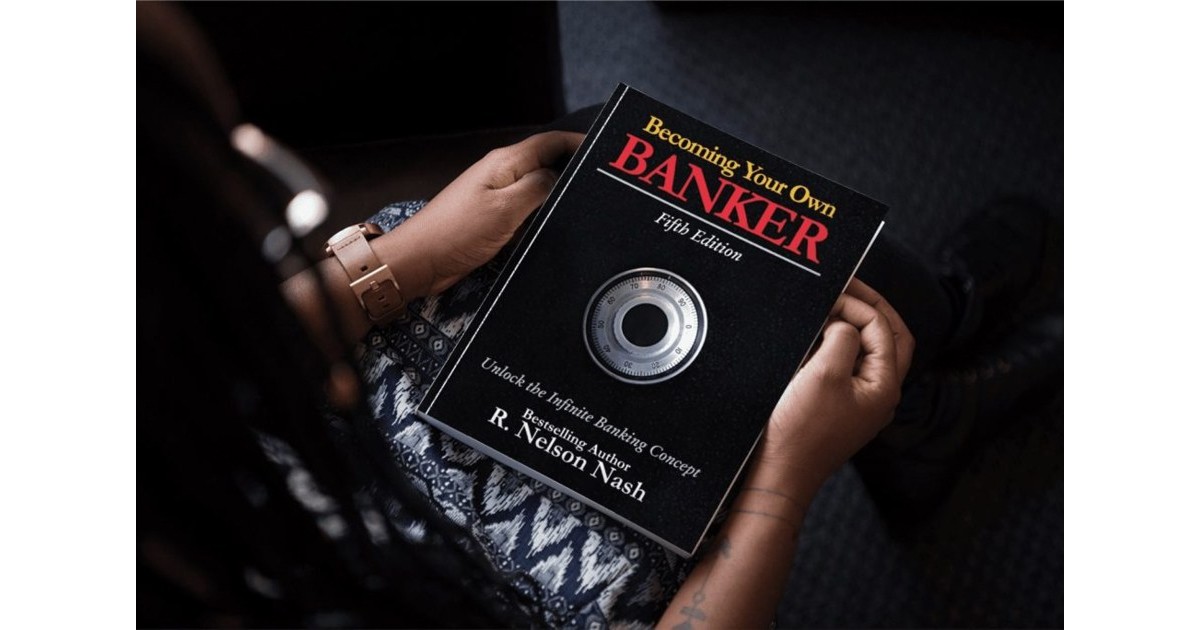
Nelson said at the start of his book that this is an exercise in imagination, reason, logic and prophecy. You have to set aside your biases and what you think you know about the financial world. Do that for a while and you will start to see things differently.
He also said that most people would rather die than think. Busy lives make it hard to think past the weekend. But money holds a place in everything we do. Financial conversations can be stressful. They are still worth having, so you can work out what matters most to you.
If you keep repeating the same process and expect a different outcome, you are close to the definition of insanity.
The book I keep pointing people to is Becoming Your Own Banker by R. Nelson Nash. Add it to your wealth-building library.
Who is the banker in my life right now?
You already have one. Every time you finance a car, carry a balance, refinance a home or borrow for your business, someone is profiting from the banking function in your life.
You can keep negotiating with banks without realizing it is a game you do not own. Or you can ask a question few people ask. How much of the banking function, as it relates to my needs, can I responsibly bring back under my control?
Wealthy people do not just own assets. They think differently about the movement of capital. So do banks.
Once you see this concept for what it is, you will not be able to unsee it. You will notice it in every car loan, mortgage and business expansion.
If you are not controlling the process, it is not you. The banking function can and should be controlled by you.
Money flows. It is always being stored somewhere and borrowed from somewhere. Start thinking like a banker instead of behaving like a borrower, and everything changes.
Popular Posts
- Infinite Banking Policy Loans: How Repayment Really Works
 A policy loan can look straightforward on a statement, yet repayment affects the policy and the borrower’s wider cash flow. Infinite banking policy loans are not free money: the insurer lends against available cash value, and the policy owner remains responsible for managing a real debt.
- Accessing Life Insurance Cash Value: Loans, Withdrawals and Surrender ComparedCan you use life insurance cash value while you are alive? Sometimes, if your policy has cash value and its terms permit access. A loan, withdrawal and surrender affect your policy differently; none is cost-free cash.


Share This Post

Categories & Tags